What Shipping a Bottle of Hot Sauce Direct Actually Costs
Make your own: hot sauce recipe builder → Choose a pepper, scale a sourced recipe, and print your batch.
Freight decides whether a single bottle sold online makes money. Four numbers drive the bill: billable weight, distance band, the surcharge USPS applies to packaging that holds more than 24 ounces of liquid in glass containers, and the carton the bottle travels in. A five-pound case pays 13.75 dollars to Zone 1 and 27.45 dollars to Zone 8 at retail. The bottle inside it costs about half a dollar at case quantity. This article works through those levers in the order they hit an invoice, then sets packaging, breakage and claim cost beside them, because a paid claim never returns the sauce.
Billable weight is rounded before it is priced
Postage is charged on a rounded weight, not the weight on your scale. A parcel weighing 4.2 oz is billed at the 8-oz price. Once a parcel passes 15.999 oz, the same logic runs in pounds: a parcel weighing 8.3 lb pays the 9-lb price. Nothing is charged for the fraction you actually used.
That rounding compounds at the low end. Ground Advantage retail postage starts at $8.40 at a Post Office counter, and any sub-pound shipment climbs the 4 oz, 8 oz, 12 oz, 15.999 oz ladder one step at a time. A four-bottle gift pack that lands at 1 lb 2 oz is billed as 2 lb, which is a full pound of postage for an ounce of sauce.
The ceiling matters too. The maximum Ground Advantage weight is 70 lbs, so a multi-case order stops being a parcel problem and becomes a freight decision. Above that weight no amount of careful packing keeps it inside the small-parcel network.
Practical consequence: weigh the finished, taped, labelled parcel, not the bottles. Glass, cap, carton and void fill are most of the grams. A five-ounce bottle holds 5.20 fl. oz to the brim, so roughly five ounces of the parcel is sauce and the rest is packaging.
Dimensional weight rarely bites on a bottle case
Carriers price large light parcels by the space they occupy. USPS applies dimensional weight to a parcel larger than 1 cubic foot, or 1,728 cubic inches, and calculates it as length times width times height divided by 139. Any fraction of an inch is rounded up to the next whole inch first, so a measurement of 10.2 inches is treated as 11.
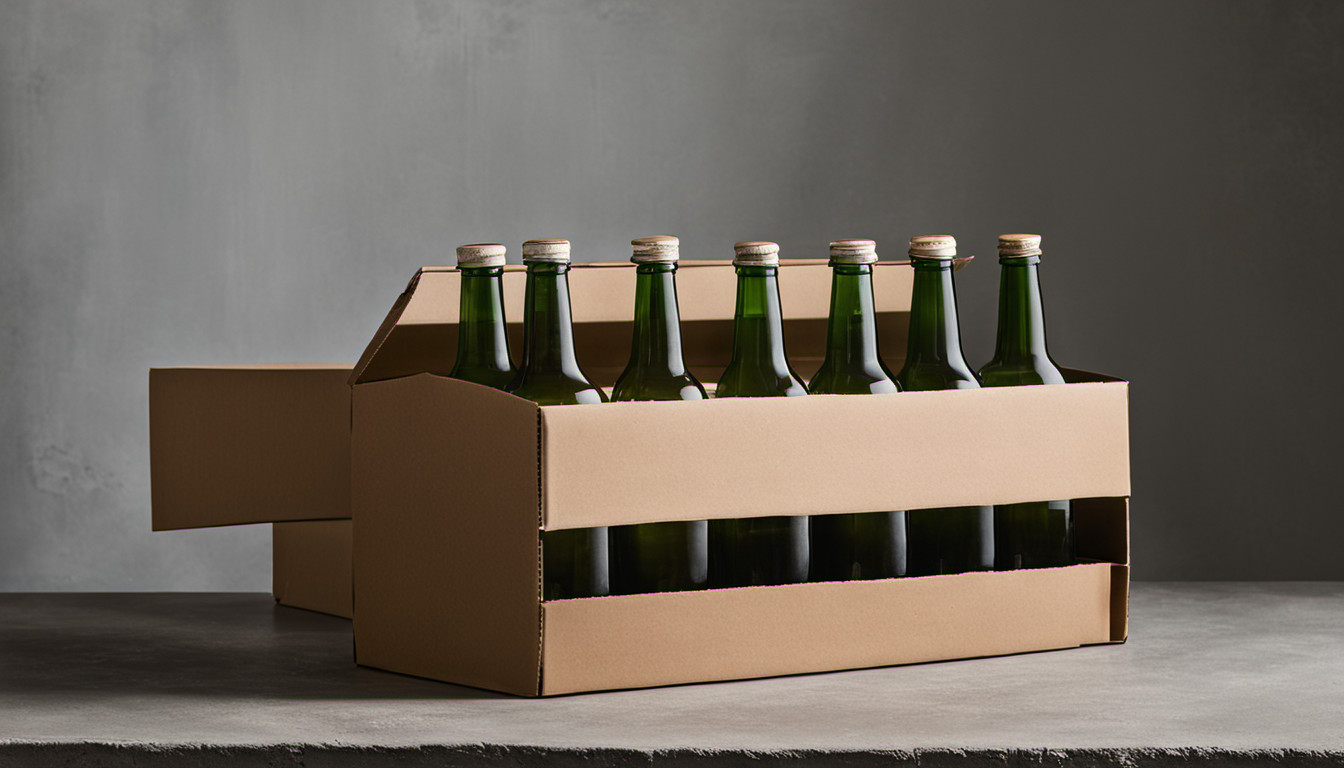
A bottle carton is a case where the arithmetic works in the shipper's favour. The 12-bottle carton Fillmore ships a five-ounce woozy in measures 8 by 6 by 7.25 inches. That is about 348 cubic inches, an eighth of the trigger volume. Dimensional weight does not apply to it, and the billable weight is simply the actual weight rounded up.
A larger outer carton can change that. Two case cartons boxed together with void fill can exceed 1,728 cubic inches, which puts the parcel into the dimensional calculation and can price it above its real weight. The fix is geometric: keep outer boxes close to the bottles, and avoid a box chosen for generous padding.
Rounding inches up matters as much as the divisor. Because every dimension is rounded before multiplication, a carton designed at 11.5 by 11.5 by 11.5 inches is priced as 12 by 12 by 12, which is 1,728 cubic inches, the threshold itself. Design to whole inches or accept the jump.
Glass over 24 ounces draws a nonstandard fee
USPS publishes a surcharge for packaging it cannot run through its machinery, and glass bottles are named in it. Packaging that contains more than 24 ounces of liquid in glass containers is classed as a nonstandard shape or material, and that classification adds $4.00 to the postage.
The threshold is per parcel, not per bottle. A single five-ounce bottle holds well under the limit. Four bottles hold 20 ounces. A five-bottle carry pack holds 25 ounces and crosses the line, so the same sauce in the same glass pays $4.00 more purely because of pack size.
Other nonstandard triggers are easier to avoid. A parcel between 22 and 30 inches long adds $4.50. A parcel larger than 2 cubic feet, or 3,456 cubic inches, adds $21.00. Those fees are aimed at long tubes and oversize cartons rather than a bottle case, but they set the ceiling: the maximum combined length and girth for a USPS parcel is 130 inches.
The $4.00 is not avoidable by packing better; it is triggered by what is inside. The choices are to keep glass-liquid volume under 24 ounces per parcel, to move to plastic for multi-bottle packs, or to price the fee into the shipping line rather than absorbing it in the product margin.
Distance moves the price more than weight does
Zone is the variable a shipper cannot control, and on a case of sauce it dominates. In the USPS retail table, a five-pound parcel costs 13.75 dollars to Zone 1, 15.35 dollars to Zone 3, 18.85 dollars to Zone 5 and 27.45 dollars to Zone 8. The same box, the same sauce, twice the postage.
Weight is the smaller lever at this size. A one-pound parcel to Zone 1 costs 10.05 dollars, while the five-pound parcel to the same zone costs 13.75 dollars. Multiplying the weight by five adds 3.70 dollars. Crossing the country at constant weight adds 13.70 dollars.
An eight-pound parcel to Zone 8 shows both effects together at 34.55 dollars. Even a sub-pound parcel is not exempt: a twelve-ounce shipment to Zone 5 is 11.70 dollars, against 10.05 dollars for a full pound to Zone 1. Distance outweighs the scale at every size in the table.
For pricing, that argues for zone-banded shipping rates rather than one flat number, or for a flat rate deliberately set at the Zone 5 to 6 cost and accepted as a subsidy to nearby buyers. A single national shipping price built on the Zone 1 column loses money on most of the country, and one built on Zone 8 repels local orders.
Bottle, carton and pack cost less than postage
Container cost is the part makers overestimate. Fillmore lists a case of 12 five-ounce woozy bottles at $5.99, which is about $0.50 a bottle. At 1,872 cases the same case is $3.99, about $0.33 a bottle. Uline prices its five-ounce glass woozy, model S-21720, at $.85 each on two cases and $.80 each on four or more, 12 per case.
Caps sit outside that price: Fillmore lists lids as sold separately from the bottles. The bottle geometry sets both: it stands 6.75 inches tall with a 1.75 inch outside diameter, so a label panel and a cap are sized to that neck and body rather than chosen freely.
Shipping packaging is a real line item for small orders. Hot Sauce Pod charges $1.55 per four-pack box at a minimum of 25 boxes. That is $0.39 per bottle of packaging, which is close to the glass itself. The insert is the reason the price holds: a corrugated insert holds each bottle flat in its own lane so a box of three or four ships with no bubble wrap, no paper and no rattle.
Fit is the constraint to check before ordering. The 5 oz pod takes bottles up to 7 inches tall and 1.81 inches in diameter, so a taller bottle with a shrink band needs a different box. A 3-pack pod weighs under a pound empty and fits a #5 padded mailer, which is the difference between a parcel priced on the ounce tiers and one priced by the pound. Add ingredient cost and fill labour to those three lines and the per-bottle total is what the BatchCostPerBottle tool computes.
Breakage cost lands after the sale
Insurance covers the bottle, not the transaction. Ground Advantage includes $100 of insurance on outbound and return shipments, and additional coverage up to $5,000 can be bought against loss or damage. That covers the declared value of the contents, not the customer relationship, the review, or the replacement shipping you pay to make it right.
The claim process has its own clock. A damaged-parcel claim must be filed no later than 60 days after the mailing date, and USPS usually sends decisions within 5-10 days. Practical advice from the claims page is to save the original packaging and everything in the package until the claim is settled, which means the customer has to keep the broken glass rather than tidy it away.
Uninsured parcels are the real exposure. USPS may not legally pay compensation for uninsured lost or damaged articles, so a package sent without the included coverage has no recovery path. Every Ground Advantage parcel carries the $100 automatically; the gap appears on higher-value multi-bottle orders where $100 does not cover the contents.
Rates are also moving. FedEx package standard list rates for U.S., export and import services increase an average of 5.9%. A shipping line built on last year's published rate is a margin leak, so re-price the same five-pound test parcel against the current table before each rate change.
What a five-pound case costs to post, retail, by zone
USPS Ground Advantage retail prices for a 5 lb parcel, Zone 1 through Zone 8, from the published retail table. Same box, same weight; only distance changes.
| Item | Value | Unit |
|---|---|---|
| Zone 1 | 13.75 | USD |
| Zone 2 | 14.35 | USD |
| Zone 3 | 15.35 | USD |
| Zone 4 | 16.6 | USD |
| Zone 5 | 18.85 | USD |
| Zone 6 | 21 | USD |
| Zone 7 | 23.8 | USD |
| Zone 8 | 27.45 | USD |
Batch cost per bottle
Enter your own batch numbers. The calculator adds ingredients, packaging and labor, then divides by the bottles the batch actually fills. It does not assume a price for you.
Peppers, vinegar, salt, spices, any purchased mash.
Use the count that passed QA, not the theoretical yield.
Delivered cost per bottle, including caps and shrink bands.
Printed label cost per bottle at your order quantity.
Cooking, filling, capping, labeling and cleanup.
Your own wage, including the owner's time.
- Packaging
- $123.60
- Labor
- $132.00
- Batch cost
- $315.60
- Cost per bottle
- $2.63
Excludes fixed costs such as kitchen rent, permits and insurance; add those separately when you price the bottle.
FAQ
What does it cost to ship one bottle of hot sauce?
It depends on zone and rounding more than on the bottle. A one-pound parcel to Zone 1 is 10.05 dollars at retail, and a single five-ounce bottle plus carton usually lands in the 12 oz to 15.999 oz tiers. Keep glass-liquid volume under 24 ounces and the $4.00 nonstandard fee does not apply.
Do glass hot sauce bottles cost more to ship?
Yes, in one specific case. Packaging that contains more than 24 ounces of liquid in glass containers is classed as nonstandard and adds $4.00. A single bottle or a four-pack stays under the threshold; a five-bottle pack crosses it.
Does dimensional weight apply to a case of hot sauce?
Rarely. USPS calculates dimensional weight only above 1 cubic foot, dividing length by width by height by 139. A 12-bottle carton measuring 8 by 6 by 7.25 inches is about 348 cubic inches, far below the trigger.
Is shipping insurance worth it on a bottle order?
Ground Advantage already includes $100 of coverage, and extra coverage up to $5,000 can be purchased. Claims for damage must be filed within 60 days, and uninsured articles may not be compensated at all.
How much does the bottle itself add per unit?
About $0.50 at case quantity: a case of 12 five-ounce woozy bottles lists at $5.99. Uline prices the same size at $.85 each on two cases, and a four-pack shipping box adds $1.55 per box.