Why Hot Sauce Separates and What Actually Holds It Together
Make your own: hot sauce recipe builder → Choose a pepper, scale a sourced recipe, and print your batch.
A bottle that splits is not one problem. Water can weep out of a gel, solids can drop out of suspension, and oil can gather at the neck, and each has a different cause and a different fix. The regulation separates the jobs too: suspending agents sit inside the stabilizer class, while emulsifiers are the substances that modify surface tension in an emulsion. The two workhorses in a pepper sauce carry different rules. Guar gum has a numeric ceiling of 1.2 percent in gravies and sauces. Xanthan gum has no dose ceiling, only a viscosity specification of 600 centipoises for a 1 percent solution. This article measures each failure, then the gum that answers it.
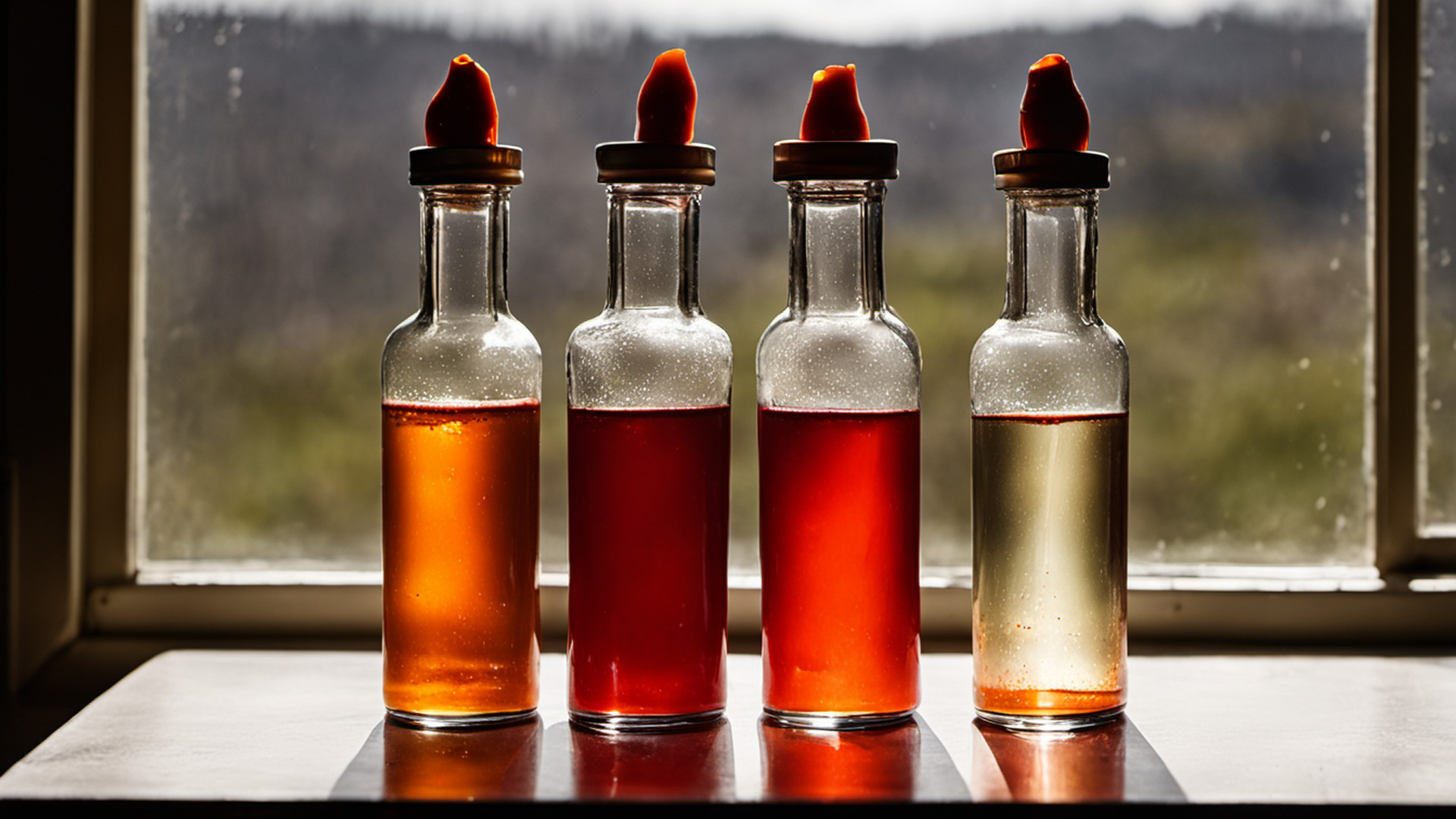
Separation starts as a gel losing water
The watery layer on top of an old bottle is usually syneresis. The gel lets go of some of the liquid it was holding. Nothing has spoiled and nothing has been added; the network that trapped the water has simply tightened.
Ketchup behaves the same way, and extension guidance names it as a gel rather than a liquid. During storage the structure contracts and loses its power to hold water. Temperature does part of the work: some gels are looser when hot and tighten on cooling, which pushes water out as the bottle comes down to room temperature.
That explains why a sauce can look perfect on the filling line and split on the shelf three weeks later. The failure is time and temperature, not a bad batch. It also explains why shaking fixes the appearance without fixing the cause: the water goes back into the network temporarily, and the same contraction resumes.
For a thin sauce the visible result is a clear layer at the top with a thicker body underneath, and the two do not remix evenly once the gel has contracted. A thickening agent can slow that contraction, which is why gums appear in commercial sauces at all. Extension guidance is explicit that they help control the problem rather than eliminate it.
Three failures get blamed on one another
Water weeping out of a gel, solids falling out of suspension, and oil rising to the neck all read as separation to a customer, and the fix for one does nothing for the others. The regulatory vocabulary is a useful map because it names the function each ingredient performs.
Stabilizers and thickeners are the substances that produce viscous solutions or dispersions, impart body, improve consistency or stabilize emulsions, and the class explicitly includes suspending and bodying agents. Suspension is therefore a named job, not an accident. A sauce carrying visible pepper solids needs something holding those particles up, and suspending agents are part of the stabilizer class the definition names.
Oil is a separate problem. Emulsifiers are defined as substances that modify surface tension in the component phase of an emulsion to establish a uniform dispersion or emulsion. That is a different mechanism from thickening a continuous phase, and an ingredient chosen for viscosity may not deliver it.
A gum can still help an emulsion without being an emulsifier, by raising the viscosity of the water phase so droplets move more slowly. That is a physical delay rather than a chemical fix, and it explains why a sauce can look stable for weeks and then break all at once when the droplet size or the temperature moves. Diagnosing which of the three failures is happening is the step that decides which ingredient is worth adding.
Xanthan is specified by viscosity, not by dose
Xanthan gum is the gum with no percentage limit in the regulation, and the reason is that its identity is defined by measured behaviour rather than by a number of grams. The additive is a polysaccharide gum derived from Xanthomonas campestris by a pure-culture fermentation and purified by recovery with isopropyl alcohol. Its dominant hexose units are D-glucose, D-mannose and D-glucuronic acid.
The specification is a rheology test. A 1 percent solution with 1 percent potassium chloride, stirred for two hours, must reach a minimum viscosity of 600 centipoises at 75 °F. The same test fixes heat behaviour: the ratio of viscosities at 75 °F and 150 °F must fall between 1.02 and 1.45. A solution that barely thins when heated is what makes the gum survive a hot fill.
Permitted use follows good manufacturing practice, as a stabilizer, emulsifier, thickener, suspending agent, bodying agent or foam enhancer. That list is broader than most makers assume; suspension and body are separate permitted functions under the same ingredient.
Supplier data fills in the handling. Food-grade xanthan is cold and hot soluble and pH tolerant, and it is sold as a thickener for suspension, viscosity and moisture retention. For an acidified sauce that must stay pourable at refrigerator temperature, that combination is why xanthan is usually the first gum tried and the one most often overdosed, since the same molecule that holds solids up will also make the sauce coat the bottle like syrup.
Guar has a numeric ceiling in sauces
Guar gum is regulated with an actual number for the category a hot sauce belongs to. It is permitted in gravies and sauces at a maximum of 1.2 percent as served, as a formulation aid and stabilizer and thickener. That is the ceiling for the finished food, not a suggested starting dose, and it applies because the ingredient is affirmed as GRAS with defined limits rather than cleared for good manufacturing practice with none.
The source material is a seed. Guar gum is the natural substance obtained from maceration of the seed of the guar plant, Cyamopsis tetragonoloba. Its handling profile differs from xanthan in ways that matter in an acid sauce: it hydrates in cold water with high low-shear viscosity and is strongly shear-thinning, so it thickens a still sauce and flows when poured.
The limitation is pH. The supplier states a stable range of pH 5 to 7. An acidified pepper sauce reading below that band sits outside the range the supplier names, and a formulator should treat the guar performance claim as untested there rather than assume it transfers.
Guar also has a texture cost and an upside. It is a better emulsifier than locust bean gum, which matters if the sauce carries oil, and it shows viscosity synergy with xanthan, so a blend can reach a target body with less of either. The 1.2 percent ceiling still applies to the guar fraction of that blend.
Locust bean gum is capped lower than guar
Locust bean gum is the third option and the one with the tightest general limit. It is primarily the macerated endosperm of the seed of the locust or carob bean tree, Ceratonia siliqua. Its regulation lists specific categories with individual maxima, then closes with a catch-all: all other food categories are limited to 0.5 percent.
A hot sauce is not one of the listed categories, so the catch-all governs it. That makes locust bean gum the most tightly capped of the three gums discussed here, at less than half the guar ceiling for sauces. It is still useful, because it is a different molecule with a different mouthfeel, and the cap is a ceiling rather than a target.
The trade-off is emulsifying strength. Guar is the better emulsifier of the two, so a sauce whose problem is an oil film gains less from switching to locust bean gum than from fixing the emulsion itself. Where locust bean gum earns its place is body in a sauce that is already stable and simply too thin.
Read the regulation as a boundary, not a formula. A permitted maximum tells you what a formula may contain; it says nothing about what the sauce will taste like at that level, and extension guidance warns that pushing gum levels produces a stiff, rubbery result. The ceiling and the sensory limit are two different numbers, and the usable one is usually the lower.
Dose to the symptom and stop early
The practical sequence is to name the failure, pick the ingredient that addresses it, then stop adding before the texture turns. Weeping water is a gel problem. Solids dropping out is a suspension problem, which the stabilizer class covers through suspending agents. Oil gathering at the neck is an emulsion problem, which is the emulsifier definition.
Next, check that the ingredient's stated working range covers your sauce. Xanthan is described as pH tolerant and cold and hot soluble, with a specification that holds its viscosity through a heat step. Guar is stated as stable from pH 5 to 7. A sauce that reads below that band is outside the guar range, and no amount of blending changes what the supplier claims.
Then respect the ceilings. Guar is capped at 1.2 percent in gravies and sauces, locust bean gum at 0.5 percent in categories it does not list, and xanthan at good manufacturing practice with no percentage figure at all. Only one of those three numbers is a limit you could accidentally exceed without noticing.
Finally, expect the texture bill. Gelling ingredients can control syneresis and still deliver a stiff, rubbery product, and the sensory failure arrives before the regulatory one does. A blend of xanthan and guar buys body from synergy between the two instead of loading either gum to its ceiling. The RecipePercentages tool converts whatever percentage the formula settles on into grams for a given batch mass, which is the point where a percentage stops being abstract.
Maximum guar gum FDA permits, by food category
Maximum permitted guar gum levels under 21 CFR 184.1339, in percent by weight of the food as served. Gravies and sauces, the category a hot sauce falls in, sit at 1.2 percent - a legal ceiling, not a recommended dose.
| Item | Value | Unit |
|---|---|---|
| Baked goods and mixes | 0.35 | percent |
| Breakfast cereals | 1.2 | percent |
| Dairy products analogs | 1 | percent |
| Fats and oils | 2 | percent |
| Gravies and sauces | 1.2 | percent |
| Jams and jellies, commercial | 1 | percent |
Recipe percentages to grams
Enter the batch mass and each ingredient's share. The calculator converts the percentages into grams so a tested ratio can be reproduced at a different batch size.
| Ingredient | Percent | Grams | Remove |
|---|---|---|---|
| 1,100 g | |||
| 500 g | |||
| 240 g | |||
| 60 g |
Total: 95.0% of the batch
Percentages are by weight. A tested recipe still needs its own pH and process checks; this tool only does the arithmetic.
FAQ
Why does my hot sauce separate into water and solids?
The watery layer is usually syneresis, where the gel lets go of liquid it was holding. Ketchup is a gel too, and its structure contracts during storage and loses its power to hold water. Shaking recombines it temporarily; gums can help control syneresis without reversing it.
How much xanthan gum should go into hot sauce?
The regulation sets no percentage, only good manufacturing practice as a stabilizer, thickener or suspending agent. The specification that defines food-grade xanthan is a 1 percent solution reaching 600 centipoises at 75 °F. Start well below the level where the sauce turns syrupy.
Is guar gum or xanthan gum better for an acidic sauce?
Xanthan is the safer bet in an acid sauce. Food-grade xanthan is pH tolerant and cold and hot soluble. Guar gum is stated as stable at pH 5 to 7, which is above the range an acidified pepper sauce sits in, though guar is the better emulsifier of the two.
What is the legal limit for guar gum in hot sauce?
Guar gum is permitted in gravies and sauces at a maximum of 1.2 percent as served, as a formulation aid and stabilizer and thickener. Locust bean gum is tighter: 0.5 percent in food categories its regulation does not list.
Does adding gum stop hot sauce from separating for good?
No. Extension guidance describes gums as a way to help control syneresis that can also produce a stiff, rubbery product. They slow water loss and act as suspending agents in the regulation's own terms; they do not stop the gel network contracting over storage.